
Bamboo Houses in Nigeria: Why Building Code and Mortgage, Not Material, Is Blocking Affordable Housing

Nigeria is facing a housing deficit of over 22 million units, and the rising cost of cement, iron rods, and finishing materials has pushed the cost of a two-bedroom house to between 62 million and 180 million naira. In response, the Federal Ministry of Innovation, Science and Technology is promoting bamboo as an alternative material for affordable housing, with technical support from the Nigerian Building and Road Research Institute, NBRRI.
The idea sounds simple. Grow the building material instead of importing it. Nigeria has about 1.59 million hectares of bamboo, which is about 35 percent of Africa’s total natural bamboo stock, mostly spread across the South East, South South and Middle Belt. But the conversation about bamboo in Nigeria is often misunderstood.

Most Nigerians picture bamboo construction as bamboo poles tied together and used to replace iron rods inside concrete slabs and beams. That practice, often seen in viral WhatsApp videos from building sites in Anambra and other states, has been rejected by construction professionals. Experts say concrete retains moisture, which causes bamboo inside it to rot, and bamboo expands differently from steel, which weakens its bond with concrete. There is no regulatory approval for using bamboo as reinforcement in Nigeria.
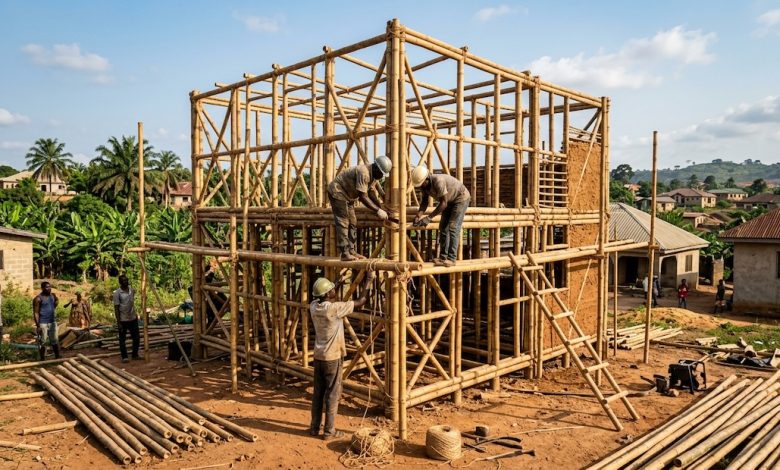
Real bamboo construction is different. Bamboo is used as a structural frame that carries load in open air, protected by wide roof overhangs and raised off the ground on concrete or steel plinths to prevent contact with moisture and termites.
On the question of strength and durability, the international standard ISO 22156:2021 now governs bamboo structural design, with a design manual from the Institution of Structural Engineers. Under this standard, treated and well-detailed bamboo can meet a 50-year design life, which is the same benchmark used for concrete, steel and timber. The key factors are using mature bamboo harvested at 3 to 5 years, seasoning it properly, treating it with preservatives like boron, and designing for durability.
Where untreated bamboo is used or where detailing is poor, buildings have failed within 10 to 20 years due to rot. The standard addresses this by restricting the highest exposure conditions to temporary structures of less than five years.
If bamboo is structurally viable, why is it not yet solving Nigeria’s housing problem?
The answer is in four missing layers that have nothing to do with the plant itself.
First is building code recognition. Nigeria’s National Building Code has no performance criteria for bamboo covering strength, fire resistance and moisture behaviour. Without a standard, approval authorities cannot approve bamboo homes easily, and developers face uncertainty. The President of ARCON has called for collaboration between SON, COREN and NBRRI to standardise local materials like bamboo composites with proper testing and certification.
Second is industrial treatment capacity. Construction-grade bamboo requires managed plantations, grading and industrial treatment plants. Natural wild stands are not a supply chain. The federal government has started a bamboo development factory in Kogi State and feasibility studies for others in Ogun, Cross River, Kaduna, Edo, Benue, Ekiti and Taraba, but production at scale is still years away.
Third is finance. No primary mortgage bank in Nigeria currently offers a mortgage product for a bamboo-framed house, and no insurer has underwriting criteria for it. Without a building code, valuers cannot defend valuations and lenders cannot accept the houses as collateral. This makes a bamboo house less affordable in practice, because a buyer must pay cash while a more expensive block house can be financed over many years.
Fourth is cost reality. Bamboo only replaces the superstructure frame and walls. Land cost, survey, architectural drawings, approvals, foundations which take 15 to 22 percent of the budget, roofing, electrical, plumbing, doors, windows and finishes remain the same. So bamboo reduces part of the cost, it does not cut the total cost of building by half.
Where bamboo makes sense in Nigeria right now:
Bamboo scaffolding, but with formal design standards to reduce site accidents. Non-structural uses like screens, ceilings, partitions, cladding and shading. Architectural projects and public pavilions, such as the bamboo scaffolding and raffia pavilion built by HTL Africa at the Ecobank Pan African Centre on Victoria Island in Lagos. Owner-built low-rise houses on family land in bamboo-rich states like Enugu, Ebonyi, Cross River, Benue, Edo and Kogi, where the owner is building with cash. Farm lodges, market stalls and tourism structures where bamboo aesthetics add value.
For anyone planning to build with bamboo in 2026, check with your state building control agency first on what evidence they require. Insist on mature, fully seasoned and preservative-treated bamboo, design with deep overhangs, no ground contact and good ventilation, budget as cash with no mortgage, and engage an architect or engineer who has detailed bamboo buildings before.
In summary, bamboo is not a gimmick and it is not a silver bullet. It is a legitimate structural material with international standards behind it. But until Nigeria adopts performance criteria in its National Building Code and creates mortgage and insurance products for bamboo homes, it will remain a demonstration material rather than a solution to the housing supply gap.